The Spread of Artificial Intelligence and the Labor Market: The Future of Jobs Through the Lens of Hyundai Motor
Introduction
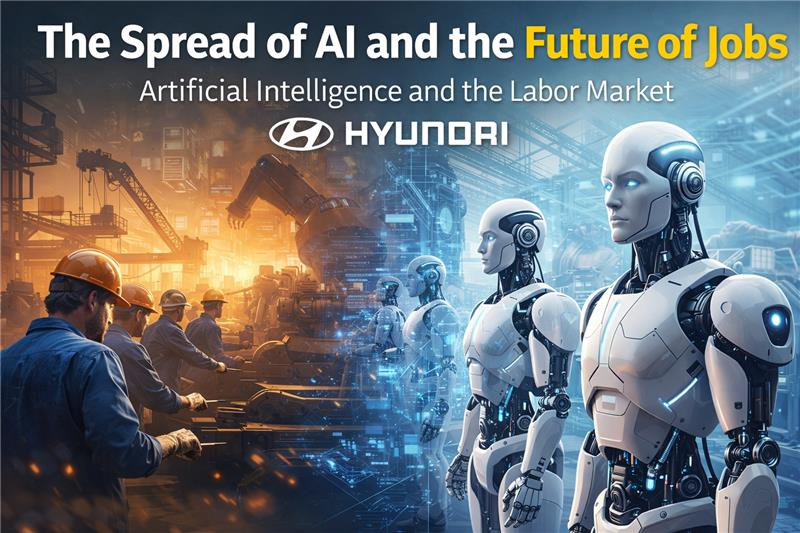
When Hyundai Motor Company moved to introduce robots into its manufacturing processes, the company’s labor union reacted immediately, and the dispute quickly escalated into a serious conflict. In early 2026, Hyundai unveiled the humanoid robot “Atlas,” developed by its subsidiary Boston Dynamics, at the Consumer Electronics Show (CES), and announced plans to deploy the robot at its factory in Georgia, the United States, beginning in 2028, with the goal of expanding its use across the entire production line. The union, however, warned that such automation would cause a significant shock to employment and declared that robots would not be allowed into the workplace without prior agreement. In fact, the union took a hard line, stating that “the introduction of new technology (robot automation) cannot be accepted without labor–management agreement,” and that “not a single robot can enter the workplace without such agreement.” This stance reflects a deep sense of crisis that the adoption of robots will lead to downsizing and job contraction. Observers have noted that if the Hyundai union were to use this issue as justification for a strike and take concrete action, it could become a highly visible example of a “jobs war” between humans and robots—roughly a year and a half after the 2024 strike by U.S. port workers opposing automation.
Such labor–management conflicts over advanced technology are by no means unique to South Korea. In the United States, for instance, the International Longshore and Warehouse Union (ILWU) went on strike across more than 30 ports in 2024 after negotiations broke down over the introduction of automation, reportedly causing economic losses of about USD 4.5 billion (approximately KRW 6.5 trillion) per day. As global firms competitively adopt artificial intelligence (AI) and robotics, workers’ job insecurity and resistance are also growing. Using the Hyundai case as an entry point, this paper examines from multiple angles the economic impacts of the spread of AI technology on the labor market.
The Current State of AI and Automation and Industry Trends
In the 21st century, artificial intelligence (AI) and robotic automation have been spreading rapidly across virtually all industries. Centered on manufacturing, the adoption of industrial robots has surged: in 2021 alone, approximately 517,000 robots were installed in factories worldwide, a 31% increase from the previous year, and the figure rose again in 2022 to about 553,000. This growth is expected to continue, with annual installations projected to reach 600,000 in 2024 and exceed 700,000 by 2026. South Korea, too, ranks as the world’s fourth-largest major robot market; in 2022 it installed roughly 31,000 units—slightly up from the prior year—while the cumulative number of robots in operation surpassed 370,000. Even more striking is South Korea’s world-leading robot density in manufacturing. As of 2023, South Korea ranked first globally with 1,012 robots per 10,000 manufacturing workers—more than double the level of just seven years earlier. In other words, on Korean factory floors, there is roughly one robot at work for every ten workers.
In the mid-2020s, as generative AI technologies (e.g., image generation and natural language processing) have advanced, the use of AI has also increased rapidly in cognitive domains that were once thought to be uniquely human—such as marketing, customer service, programming, and media content creation. The global AI market is expected to reach around USD 391 billion in 2025, and some projections suggest that, after sustaining annual growth of roughly 20–30%, it could reach USD 1.8 trillion by 2030. In short, from robotic automation in manufacturing to algorithms in office work and smart devices in everyday life, AI and automation technologies are spreading quickly and broadly across the entire economy. As a result, firms’ production methods and work processes are changing, and new opportunities for business innovation are emerging—while at the same time a major wave of change is reshaping workers’ employment conditions.
How AI Affects Labor Demand and Employment Structures
The spread of AI and automation exerts complex effects on labor demand and the structure of employment. The most prominent concern is job displacement. Since the Industrial Revolution, automation has replaced repetitive and simple tasks performed by humans, and this trend continues in the AI era. Jobs that involve standardized tasks—such as assembly-line workers in manufacturing, sorting and packing personnel in warehouses, bank tellers, and call-center agents—are often assessed as having a high risk of being replaced by AI and robots. According to a recent analysis by the World Economic Forum (WEF), office and administrative roles—such as clerical support staff and secretarial positions—are expected to decline most rapidly due to AI. Routine white-collar occupations, including bank tellers and data entry workers, are frequently cited as representative job categories likely to shrink under AI-driven change.
At the same time, AI creates new occupations. As AI adoption accelerates, new roles that did not previously exist are emerging, including prompt engineers (specialists in giving effective instructions to AI), AI quality managers, and data scientists. For example, media reports in 2023 drew attention to cases in which major companies offered exceptionally high compensation—annual salaries of KRW 200–300 million—to highly skilled prompt engineers.
Another key issue is the qualitative transformation of jobs. AI does not merely eliminate jobs; it also changes how many occupations are performed and what skills they require. With advances in generative AI, for instance, marketing planners collaborate with AI to develop ideas, while accountants automate routine calculations and shift more toward data analysis and strategic advisory work. Firms are decomposing existing roles into task bundles, reallocating which parts can be automated and which require human judgment, and strengthening employee retraining accordingly. Companies that respond successfully invest in human capital—helping employees acquire digital capabilities, redeploying them into new roles, or even transitioning them into newly created AI-related positions. These firms can generate a virtuous cycle in which AI-driven productivity gains and new business opportunities coexist with employment retention and job creation. In contrast, workers who face automation without preparation remain highly exposed to the risk of job loss. In sum, employment in the AI era is shaped not only by changes in job quantity but also by transformations in work processes and occupational structures, and outcomes will likely diverge depending on workers’ adaptability and opportunities to acquire new skills.
Effects on Wages, Working Hours, and Productivity
AI and automation also have significant impacts on economic variables such as wage levels and distribution, working hours and conditions, and labor productivity. In terms of labor productivity, automation generally raises productivity. Machines and algorithms perform repetitive tasks faster and more accurately than humans, can operate around the clock, require no rest or vacations, and tend to make fewer errors. This enables firms either to produce more output within the same time or to achieve the same output in less time, contributing to economy-wide productivity growth.
However, the picture becomes more complicated when it comes to wages and income distribution. Even if automation increases productivity, its impact on wages depends on how the gains are distributed between workers and capital owners. In an ideal scenario, firms would raise wages in line with productivity improvements, benefiting everyone. In reality, many observers point to a tendency for capital to capture a larger share of the gains, while workers’ share declines. In sectors where automation reduces the demand for human labor, workers’ bargaining power can weaken, making wages more likely to be restrained or pushed downward. In this sense, the Hyundai union’s criticism that “robot adoption merely provides justification for capitalists to maximize long-term profits” is not entirely groundless.
Next, consider effects on working hours and working conditions. One of the ideal outcomes of automation is to reduce human labor burdens and increase leisure time. Historically, productivity gains have been associated over the long run with reductions in average weekly working hours. If AI and robots shoulder more of the production burden, human workers may be able to maintain the same output with fewer working hours—or achieve higher output without increasing hours. The Hyundai union has also raised working time reduction as a key agenda item, including demands in recent collective bargaining for the introduction of a 4.5-day workweek. Such efforts to share productivity gains through shorter hours have begun to materialize in some countries. In the United Kingdom, a 2022 pilot program implementing a four-day workweek across about 60 companies and roughly 2,900 employees reported that 92% of participating firms decided to continue the policy afterward, and 18 of them adopted it as a permanent arrangement. The trial reportedly maintained productivity at levels similar to before, with little change in revenue, while employee burnout fell by 71% and sick leave decreased by 65%, indicating significant improvements in health and satisfaction. This suggests that shorter working hours do not necessarily reduce productivity, and that productivity gains can be used to improve quality of life.
Conversely, critics also warn that automation may intensify work and reduce rest. Human workers competing with AI and machines may feel pressure to work as quickly and efficiently as machines, leading to higher work intensity. Moreover, because machines operate 24 hours a day, shift work or nonstandard schedules may increase, potentially worsening working conditions. In platform labor or remote work environments, the development of digital surveillance technologies has also expanded—allowing employers to track task performance and quantify output, thereby assigning more work. These phenomena imply that if technology is used primarily as a tool for management or control, working conditions may deteriorate rather than improve. Therefore, realizing the positive effects of automation—such as reduced working hours and lower work intensity—requires not only technology adoption but also human-centered workplace design and reasonable labor regulation. Ideally, AI and robots would take on dangerous or difficult work while humans focus on more creative and distinctly human tasks, alongside reductions in working hours. Achieving this, however, demands active coordination among labor, management, and government, as well as strong policy support.
Responses by Workers, Firms, and Governments and Policy Considerations
To proactively manage labor market changes driven by AI and automation and to mitigate negative impacts, coordinated efforts are needed from workers, firms, and governments alike. For workers, continuous learning and skill development are essential. To adapt to rapidly changing technological environments, workers must embrace lifelong learning and acquire new skills and knowledge. Manufacturing workers may need training in robot operation and maintenance, while office workers may need to develop capabilities in data analysis or AI utilization. Such reskilling enables workers to use AI as a supportive tool in their jobs or transition into higher value-added work, making coexistence with machines possible. At the collective level, labor unions also play an important role in demanding employment safeguards when new technologies are introduced. As the Hyundai case illustrates, unions can insist that technology adoption not lead to unilateral downsizing but instead include alternatives such as redeployment and retraining. By clearly stating a principle such as “new robot technologies cannot be introduced without labor–management agreement,” the union pressures management to negotiate over employment impacts as part of the adoption process. In this way, workers can use bargaining power to influence the pace and manner of technological change and demand support for transitions, training, and appropriate compensation. More broadly, labor may also need to engage in social discussions about reducing working hours or sharing the benefits of new technologies through mechanisms of gain-sharing.
The role of firms is also decisive. Companies are both the main agents of technology adoption and responsible for managing human resources under its impacts. Firms should adopt a human-centered technology strategy. Rather than treating AI and robots merely as tools to cut labor costs, companies must simultaneously consider how to help existing employees adapt to new environments. This includes strengthening in-house training programs, redesigning work so that humans and machines can collaborate effectively, and introducing participatory decision-making that reflects frontline workers’ views on AI operating standards and ethical issues. Ultimately, when firms view workers not simply as costs but as assets—and approach technology as a means to enhance the value of those assets—innovation in the AI era can coexist with labor–management cooperation and shared prosperity.
Finally, the role of government and policymakers is crucial. Governments must coordinate the macro-level labor market impacts of technological change and reinforce the social safety net. Educational reform and investment in vocational training are urgent priorities. Examples include government-led training programs, subsidies for training costs, and the provision of online learning platforms. Many countries have introduced adult reskilling grants and transition training vouchers to support labor reallocation. In addition, governments should strengthen social protection systems so that those who lose jobs due to technology can access unemployment benefits, health insurance, and livelihood support. Over the longer term, more radical proposals—such as a robot tax or universal basic income—may also be considered. A robot tax would impose additional taxes on firms benefiting from robot adoption and use the revenue to support displaced workers and reskilling. Universal basic income would guarantee a minimum income to all citizens regardless of employment status and is often discussed internationally as a potential safety net in an era of mass technological unemployment. While controversial, such policies continue to be debated as possible social responses to technology-driven job displacement.
Conclusion
The labor–management conflict surrounding Hyundai Motor’s plan to introduce robots vividly illustrates the challenges facing labor markets in the age of artificial intelligence. The rapid spread of AI and automation offers opportunities for industrial innovation and productivity growth, but it also carries risks of job losses and widening inequality. Technology is, in itself, a neutral tool; depending on how it is used and governed, it can either become a positive force for labor or a source of severe disruption. On the one hand, AI has the potential to improve job quality by taking over tasks that are difficult for humans and by creating new, value-added roles. On the other hand, the unprepared and uncompensated introduction of technology can push workers out of employment and make even remaining jobs more precarious. Amid this duality, the direction forward is clear. If technological progress cannot be stopped, then we must infuse it with human values and seek a path of coexistence.


댓글